Finding the real problem with ON!Track's storage assets

Summary
ON!Track is Hilti's asset-management software. Construction companies use it for transparency over their tools, for cost, for accountability and for audits. Inside it, a storage asset is anything that holds other assets: a van, a site container, a gangbox. The ON!Track team believed storage assets were a major pain point for users and one of the drivers of bad UX and churn. In 2023 they brought me in from Hilti's Global IT product UX team to find out whether that was true. I planned the project and ran the interviews, the expert evaluation and the analysis of the qualitative and quantitative data. The research found more than 25 UX issues, sorted them by severity and effort, and traced the worst of them to one root cause that neither the specialists nor the customers had named.

Team
Lead UX Consultant (me), Software Product Manager, Product Owner, Design Manager

Role
UX Research, Expert Evaluation, Data Analysis

Scope
5 internal interviews in 4 markets
5 users at 2 customer companies
25+ UX issues scored by severity and effort
5 hypotheses tested on customer data
Results delivered July 2023
The Problem
Storage assets had a reputation inside the ON!Track team as a source of bad UX and of churn, but nobody could say how bad, for whom, or whether fixing them would matter more than anything else on the roadmap. The team set four questions. What do customers need from storage assets, and where does it hurt? Which usability issues exist, how severe are they, and are there any the team didn't know about? Is fixing storage assets enough, or do related areas such as the asset list, quantity items and the location hierarchy need to be in scope too? And are storage assets being used well in the van-gateway tracking flows and the enhancements planned next?
- None of the five internal specialists ranked storage assets among the top half of customer issues.
- Customers could not use the feature successfully as it was built. One lost six months of migration work to it.
- Eight problems that looked unrelated shared one root cause: selecting, transferring and costing a storage asset together with everything inside it.
- The markets with the highest adoption weren't better at converting customers. They simply showed the feature to more of them.
The work was scoped to the problem space only: no concepts and no solution testing. That let the findings, not a favorite solution, decide what came next.
Research Principles
- Understand the problem before designing for it. The team could prioritize precisely only once the issues were mapped.
- "Not worth solving" is a result too. A counter-intuitive success would be learning that storage assets mattered less than other topics, and moving on.
- Connect it to the business. Without a link to revenue or another business metric, there is no way to size the investment or measure the impact of any change.
Four Methods, in Order
I combined three qualitative methods with one quantitative one, and ran them so each fed the
next. Interviews with internal specialists came first: they are the fastest way into a
problem space and they sharpen the questions for customers. But specialists are a step away
from the customer and can bring their own assumptions and ideas, so customer interviews came
next. An expert evaluation then consolidated earlier evaluations by product owners, product
managers and designers, and followed up everything the interviews raised. Finally, a
hypothesis-driven analysis of storage-asset data across Hilti's market organizations tested
what the interviews suggested.
The option I didn't take was to rely on the data alone. It can show what is happening, but
not why people behave the way they do. That takes talking to them.
What the Specialists Said
ON!Track specialists implement the product with customers and support them afterwards. I
interviewed four specialists and a product manager from Great Britain, Finland, Denmark and
Sweden, an hour each, and asked them for blunt feedback to counter friendly bias.
All five said the same thing: storage assets were not a top-half issue. What customers
wanted was automation: Bluetooth tags, gateways, automatic transfers. Every specialist had
reached that conclusion independently, and customers paid a premium for it. Almost every
one of them had also tried setting up a toolbox as a storage asset, and each had decided it
wasn't worth the effort, mainly because batteries get swapped between tools rather than
transferred.
They still named plenty of storage-asset issues: the contents are hard to view,
navigating back from them is confusing, and selecting a storage asset when adding or
transferring is often overlooked. What matters also depends on the type. For a van, the
responsible person matters most; for a container, the location. Browser back navigation,
which lost the user's place and scroll position, hurt both efficiency and sentiment.
What the Customers Showed
I then interviewed five users at two infrastructure companies in Canada: three warehouse
managers and two back-office managers. They confirmed that storage assets weren't their
biggest concern, and showed why the feature still mattered: as built, it could not be used
successfully.
When one customer found a storage asset through search or a filter and selected it, the
contents didn't transfer with it, and it wasn't clear what had been selected. The
workaround they built cost six months of effort during their migration, left them with no
trust in the system and a very negative view of the new version of ON!Track. Their
specialist saved the relationship.
The workarounds said the rest. One customer tagged the expensive item inside a kit instead
of the kit. Another used the notes on an excavator to record which buckets and loaders
belonged to it, so search would find them together. That relationship is exactly what a
storage asset is for. Accurate records mattered to these customers because they account for
where equipment has been for regulatory audits, where mistakes cost money. They also
explained why records drift: unless it's enforced, people avoid transferring tools to
themselves so they aren't accountable for anything lost, broken or dirty.
One Root Cause, Eight Symptoms
Transfer is one of the primary jobs of ON!Track, and before transferring anything you have
to be sure you've selected the right thing. Walking that path with a storage asset turned up
eight problems, each of which had been reported before as a separate, minor issue:
1. You can't see everything inside a storage asset in one place. Checking
its contents takes you to another page, and coming back loses your selection and your
place.
2. The number of stored assets on the list card doesn't match the number
in the details.
3. Duplicate template images make storage assets hard to tell apart.
4. It isn't clear what is selected, and selection behaves differently in
browse and in search.
5. Even with the right selection, not all the contents transfer.
6. After a transfer, it's hard to confirm it worked; the current location
doesn't always update.
7. When receipt must be confirmed, the recipient can't confirm or reject
the contents.
8. The result is asset costing that is probably inaccurate, and at best
hard to trust.
Specialists and customers could each describe symptoms, but neither could see the cause
restricting what they wanted to do. Treating the eight as separate bugs would have fixed
each one and left the workflow broken. Treating them as one problem made the severity
clear: sentiment, time lost to migration and use, and a higher chance of churn.
What the Data Said
To test what the interviews suggested, I defined the variables and ran five hypotheses
against storage-asset data from Hilti's market organizations. Exposure meant a customer had
at least one storage asset, and adoption meant more than three. Market size and maturity was
the number of ON!Track customers in the market.
Three hypotheses held: larger, more mature markets had more exposure and more adoption, and
customers who had used ON!Track longer tracked more assets. Two weren't supported: that
larger markets are better at converting exposure into adoption, and that customers add more
storage assets the longer they use ON!Track. Adoption followed exposure, not time.
Adoption rose with market size, from 21% of customers in the smallest fifth of markets to
41% in the largest. That gave a benchmark of 41%, with 46 markets below it. The markets with
the highest adoption were New Zealand, Ireland, the Netherlands, the United Kingdom, Denmark
and Germany, all at 50% or more. The cheapest lever wasn't a redesign: it was making sure
customers were shown the feature at all, and asking the leading markets how they did it.
The data also raised the larger question, which it couldn't answer: does it matter? Unless
storage-asset adoption is tied to a business outcome, pushing it onto customers may not be
the right call.
Prioritizing 25+ Issues
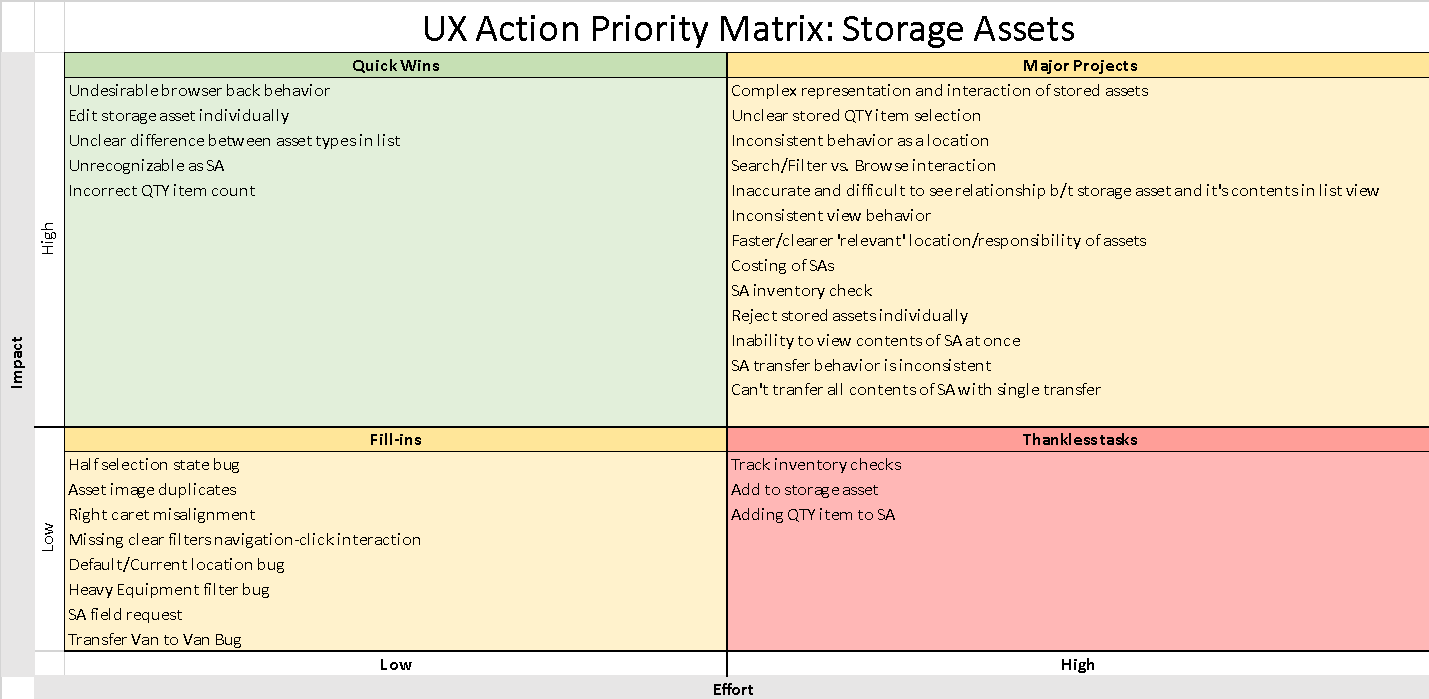
Not every issue needed the same response, so I scored each one on two axes. Effort was
four points, one for each thing it would need: further research, concept designs, concept
validation and an A/B test. Zero to two points was low effort, three or four was high.
Severity weighed how often the issue occurs, how many customers it could affect, its impact
on sentiment, and whether it sits on a critical path.
The matrix gave the team four buckets: 5 quick wins, 13 major projects, 8 fill-ins and 3
thankless tasks. The quick wins and fill-ins needed no further research and little design
effort; some were bugs that could simply be fixed. For the major projects, I
recommended that anything touching a critical path, such as selection, ship as an A/B test,
so a significant change could be shown not to be worse before full release.
Recommendations
Evaluate the issues against the rest of the ON!Track roadmap, and use the matrix to decide
what earns time next. Before investing in the major projects, establish whether
storage-asset adoption correlates with revenue or another business outcome. If it does,
the 41% benchmark becomes a target for each market, and a way to see which markets can
teach the others.
To measure any change, set a baseline and watch the trend. The report listed candidate
metrics: subscription upgrades, tool sales, churn, the conversion and adoption rates,
NPS and CSAT, app store ratings and support tickets that mention storage assets. The one
most likely to move first is the time between exposure and adoption, which changes in days
or weeks. Churn moves on a contract cycle of years.
What Came Next
I presented the results to the ON!Track team in July 2023, with a detailed report, a
spreadsheet of every issue, and Figma references showing each one in the product.
The research then fed straight into design. I sketched concepts for the two problems at the
center of it: whether to show assets as a nested or a flat list, and how to show which
assets sit inside which. In the concepts, the main asset list stays flat. A storage asset's
details show what it contains, and a stored asset's details show what it sits in.
Selecting a storage asset selects its contents too. The sketches later became Figma
designs and prototypes.
What I'd Do Differently
Recruit more customers before starting. We could only schedule two customer
interviews, which leaves room for sample bias. I would secure at least five before the
research began, and fix the recruiting process that made two the limit.
Answer the business question first. The research framed the question of
whether storage assets affect revenue or churn from the start, but finished with it still
open. I would get that correlation from the data before the interviews, so every finding
could be sized as it came in.
Watch the work, not just hear about it. A full day of contextual inquiry
with warehouse managers, plus session recordings and funnels from a behavior-analytics tool,
would have shown the path I reconstructed from interviews. I would also have separated web
and mobile from the start, rather than relying on customers to say which platform an issue
was on.
Credits
Jussi Silfver: ON!Track Software Product Manager
Kelvin Dsouza: ON!Track Product Owner
Boris Milutinovic: ON!Track Design Manager