When I was competing in the 400m hurdles, the Australian Institute of Sport published a framework that changed how I thought about performance. It was a pyramid. At the base, everyday nutrition fundamentals. In the middle, sports nutrition, whole foods and fluids timed around training. At the tip, supplements, the marginal stuff that might give you a fraction of a percent if everything below it was already handled.
The AIS drew it twice. Once the right way up, with an arrow starting at the base. And once upside down beside it, labeled as the version supplement companies would like you to believe, with the arrow starting at the tip.
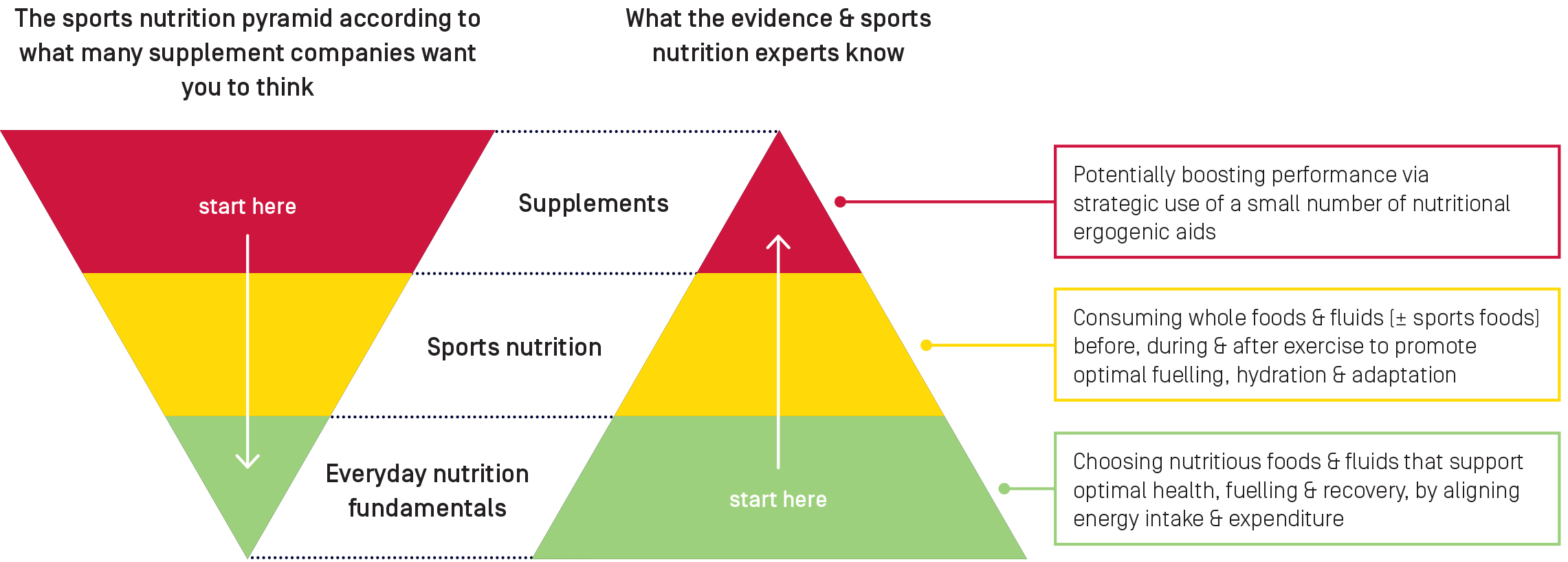
The AIS framework. The industry’s version is the one on the left, and the AIS labels it as such. Source: Australian Institute of Sport.
I trained professionally from 2010 to 2013. I used a Timex Ironman watch. Professional training is structured, repetitive and boring. There’s deep science behind periodization and recovery, but the daily execution is dull. Go to bed. Wake up. Eat clean. Train. Rest. Repeat. Every athlete at that level had the base handled. It was table stakes to even compete.
Years later, after building a healthcare company and spending time around wellness, I started seeing that inverted pyramid everywhere. I’ve bought from it too, more than once. What I want to work out here is why it keeps happening, because I don’t think it’s a story about bad people. First, though, a distinction I wish I’d made years earlier.
Health products detect and treat. They aim at a condition. A blood panel that finds your thyroid problem, a program that gets your A1c down, a physical therapy service that fixes your back. These are good. They’re measured on outcomes, they mostly get sold to employers and insurers who carry the cost of you being sick, and they’re not what this essay is about.
Wellness products have no condition to aim at. That sounds small. It decides everything. With no target there’s no outcome to measure against. What’s left is the advice that applies to everyone. Sleep more. Eat real food. Move. Manage stress. Go easy on the alcohol and the late caffeine.
All of it correct. All of it free. All of it already known. Which leaves a wellness company with nothing to sell.
The obvious answer is personalization. Here’s the part I find genuinely interesting: at the base there is almost nothing to personalize. Everyone down there needs the same handful of things. Individual differences start to matter near the tip, where the margins are fractions of a percent. Almost nobody is near the tip.
So the product personalizes something that doesn’t vary, and reports it back in high resolution. That’s metric theater. Software people use the phrase for dashboards that make a company feel measured while nothing improves. It descends from Bruce Schneier’s security theater by way of Derek Thompson’s hygiene theater, and it transfers to wellness almost too neatly.
Nobody has to be acting in bad faith. The structure produces it on its own. And then four incentives push hard in the same direction, all of them perfectly rational.
Distribution rewards the tip. Algorithms surface what’s novel and visual. A new peptide, a cold plunge protocol, a stack of twelve supplements. “Go to bed an hour earlier” has never trended and never will.
The tip has margin. A supplement is a physical good with repeat purchase and a brand. Consistency has nothing to ship and nothing to reorder. If your business needs revenue per user, the base is not where you find it.
The tip is easier for the buyer. Swallowing a capsule takes ten seconds. Sleeping seven hours a night for a year takes a year. Both feel like taking your health seriously, and only one of them is available this afternoon.
The tip converts motivation before it decays. People buy in bursts, usually after a scare or a birthday or a bad photograph. A burst is short. The tip can be sold inside it. The base needs that burst to survive contact with a Tuesday in February, which mostly it doesn’t.
Put those together and selling the tip isn’t a failure of character. It’s the correct strategy, which is exactly why it won’t correct itself. Any company that decides to sell the base instead is choosing worse distribution, worse margins and a harder pitch, on purpose.
Whoop and Oura are the clearest version of this, and I don’t mean that as an insult. The hardware is excellent and the science under it is real. But look at what they actually deliver: high-resolution information about the base. Recovery scores, strain, HRV trends, readiness percentages. All of it telling you, with impressive precision, whether you did the six things you already knew about.
That’s why the learning plateau hits so fast. Not because the product is bad, but because there was only ever so much to learn. You’ve already paid for the device and the annual subscription by then.
“Blood testing is a shit business.”
— Max Marchione, co-founder, Superpower
Large blood panels are the interesting middle. They’re trying to cross the line. Max Marchione, who co-founded Superpower, has said the economics are brutal, and that reselling Quest’s lab tests isn’t particularly lucrative. He’s right. High acquisition cost, low lifetime value, insights that are interesting more often than actionable.
But the panel was never the business. The interpretation layer is. A hundred biomarkers handed over as a PDF of reference ranges is what your doctor already does badly. Turning that into something you can act on, tracked over years, in language you understand, is a real product and a hard one. Function Health raised $298M at a $2.5B valuation in November 2025 on roughly that bet. If it works, these become health products. Until then they ship very well-presented wellness. The supplement cross-sell next to the diagnostic tells you which side the revenue is on today.
The graveyard makes the point better than I can. Arivale paired genome sequencing, microbiome analysis and blood biomarkers with human coaching. It raised over $50M and closed in April 2019 with about 5,000 customers. The coaching came down to eat better, sleep more, exercise, manage stress. Modern Age raised $33M selling $500 aging assessments and closed in March 2024, its founder saying plainly she couldn’t raise again. Bayer bought a majority stake in Care/of at a $225M valuation and shut it down in 2024. Each one looked like a health product. Each one shipped a wellness product.
Bryan Johnson is the purest illustration, and a harder case than his critics allow. He sleeps on a schedule almost nobody keeps, trains daily, eats the same disciplined diet for years, and publishes the entire protocol for free. That is the base and the middle, handled, for years on end. Copy only his sleep and his consistency and you’d get most of what’s on offer.
Which means his supplement stack is defensible in a way that almost nobody else’s is. Marginal gains are real once there is nothing left to gain underneath them, and he has genuinely run out of things to fix below. On his own terms he is using the pyramid the way the AIS drew it, from the bottom up, and he has earned the right to be up at the tip arguing about fractions of a percent. The order still holds. Base, then middle, then the tip last and smallest.
The tension isn’t the man, it’s what survives the trip to his audience. Most of them are at the base and have not run out of things to fix. What reaches them is the stack, the protocol and the $360 a month, because that is the part that is legible and purchasable and easy to share. The ordering does not travel. The tip does. That isn’t something he is doing to anyone, it’s the same four incentives operating on everything he says.
So what do you do with this. If you’re buying, the useful question is where you actually are on the pyramid, and the honest answer for almost everyone is the base. From there, one test sorts most products. Does this change what I do at the base, or does it only tell me about it? A wearable that gets me into bed an hour earlier earns its subscription. The same wearable producing a score I check and then ignore is a subscription to my own anxiety. The metric isn’t the problem. The metric with nothing attached to it is.
If you’re building, stare at those four incentives. They’re why the obvious strategy is the wrong one and the profitable one at the same time. The base does become sellable when you attach it to a goal, which is what health products do. Or to someone who’ll pay for the outcome, which is what the employer channel does. Neither is available to a consumer wellness app.
Making consistency feel like progress, without inventing a number to dress it up, is the open problem. I don’t think it’s unsolvable. I think it’s slow, and it looks boring for a long time before it works.
I’ve built in both health and wellness, and I expect to keep working in them. So take this as someone still figuring it out rather than someone who has. If you’ve seen a product that genuinely and successfully sells at the base, I’d like to know.
Thanks to Blaž Triglav and Aaron LaRue for reading drafts of this.