I had a plan for December. My last day at Circle Medical was the seventeenth, and after that, one month off. Rest, reflect, let the lessons settle, be around for the holidays. A structured plan, written down, the way I do things.
It lasted until the tenth. Which is to say it broke a week before it started.
There was so much in the news about Claude that month that I got curious in a way I couldn’t put down. Not curious enough to start one of the ideas I’d been carrying around. Just curious enough to want a data point. So I gave myself an hour. How far can you get building a real application with an AI agent? I had no intention of keeping whatever came out of it.
Fifteen minutes in, I was hooked. The repository says I made nineteen commits that first day, and a hundred and one in the first week.
What I built was an RSS reader. I picked it as a throwaway. Personal, small, no stakes, nobody else’s problem. The repo is still called vibe-reader, which tells you how long I expected it to last. Eight months on I still open it a couple of times a week. It’s called The Signal.
It survived because it solved a problem I actually had. The pace of AI progress makes it hard to stay current. The discourse makes it harder. Most of what reaches you is recycled announcements and confident takes from people who haven’t touched the thing they’re describing, and my feeds were full of it. I didn’t want a better algorithm. I wanted no algorithm. Thirteen sources, picked by hand, mid- and long-form only, mostly individual writers rather than publications. Karpathy, Graham, Thompson, a few others. The curation is the product. Everything else is a reading surface.
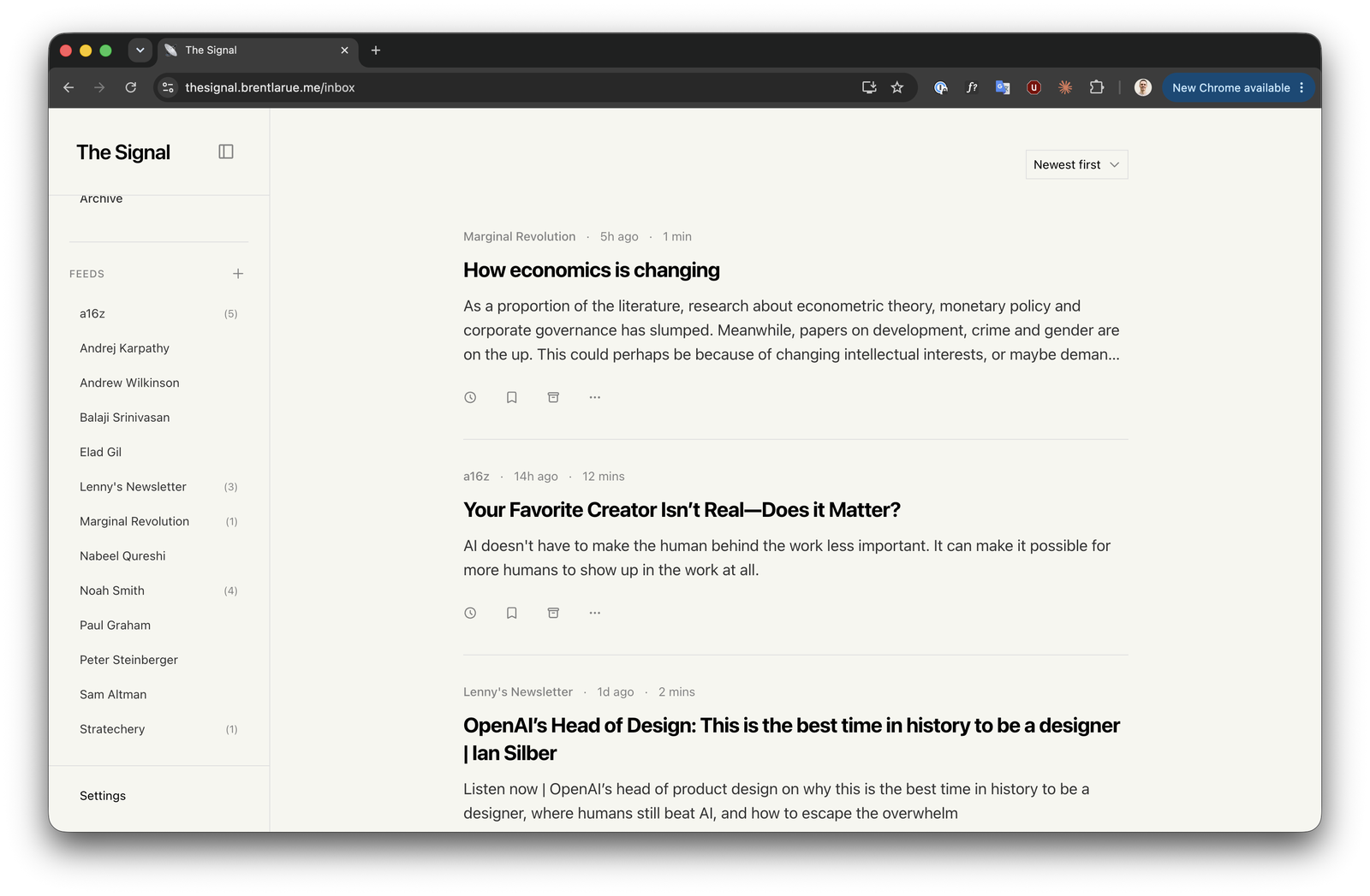
The entire recommendation engine.
I cared a lot about that surface. This is where fourteen years of doing product for a living showed up. It’s typographically serious, because I actually read in it and legibility is the whole job. Full-screen mode. Responsive from phone to desktop. Keyboard shortcuts for triage. Four themes: light, dark, sepia, and a Hacker News one, because I wanted it and nobody was going to stop me. Highlights and notes work like a Kindle. They save into one page, so I can find them again.
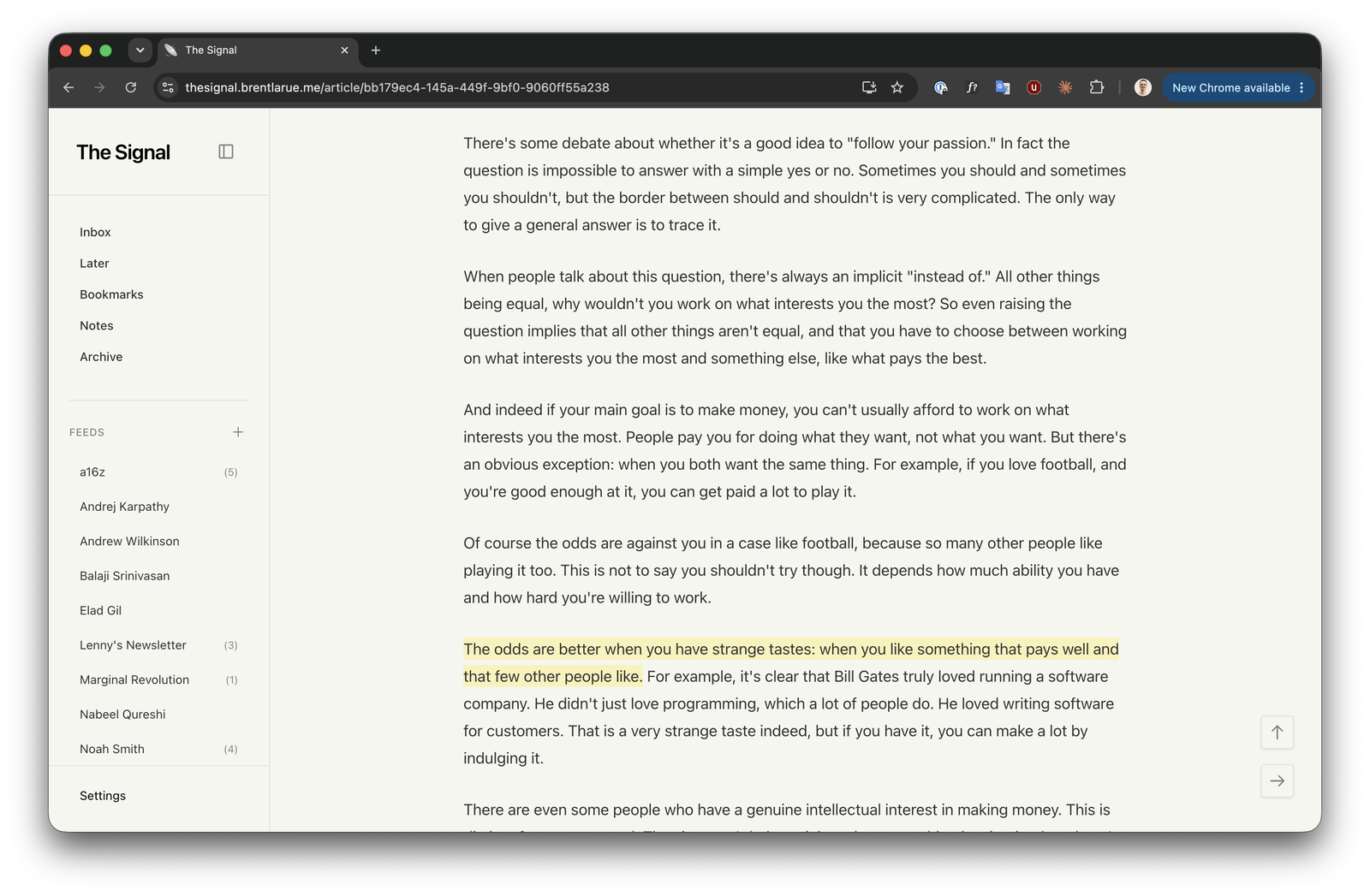
A reading surface and not much else. The line height is the product.
Then the AI layer, which changed what the thing was for. Every article can be summarized. Past that there are three lenses I built because I kept wanting them.
One drafts an insightful reply for a repost. Capped at 280 characters, banned from summarizing, banned from opening with “this piece argues”. One is an investor analysis, which reads the article the way an investment memo would: incentives, cost curves, distribution, margin. The third asks what a founder should actually do differently if the argument holds. Each is a system prompt describing a way of reasoning rather than a topic. They took a dozen rounds to stop sounding like summaries wearing a hat.
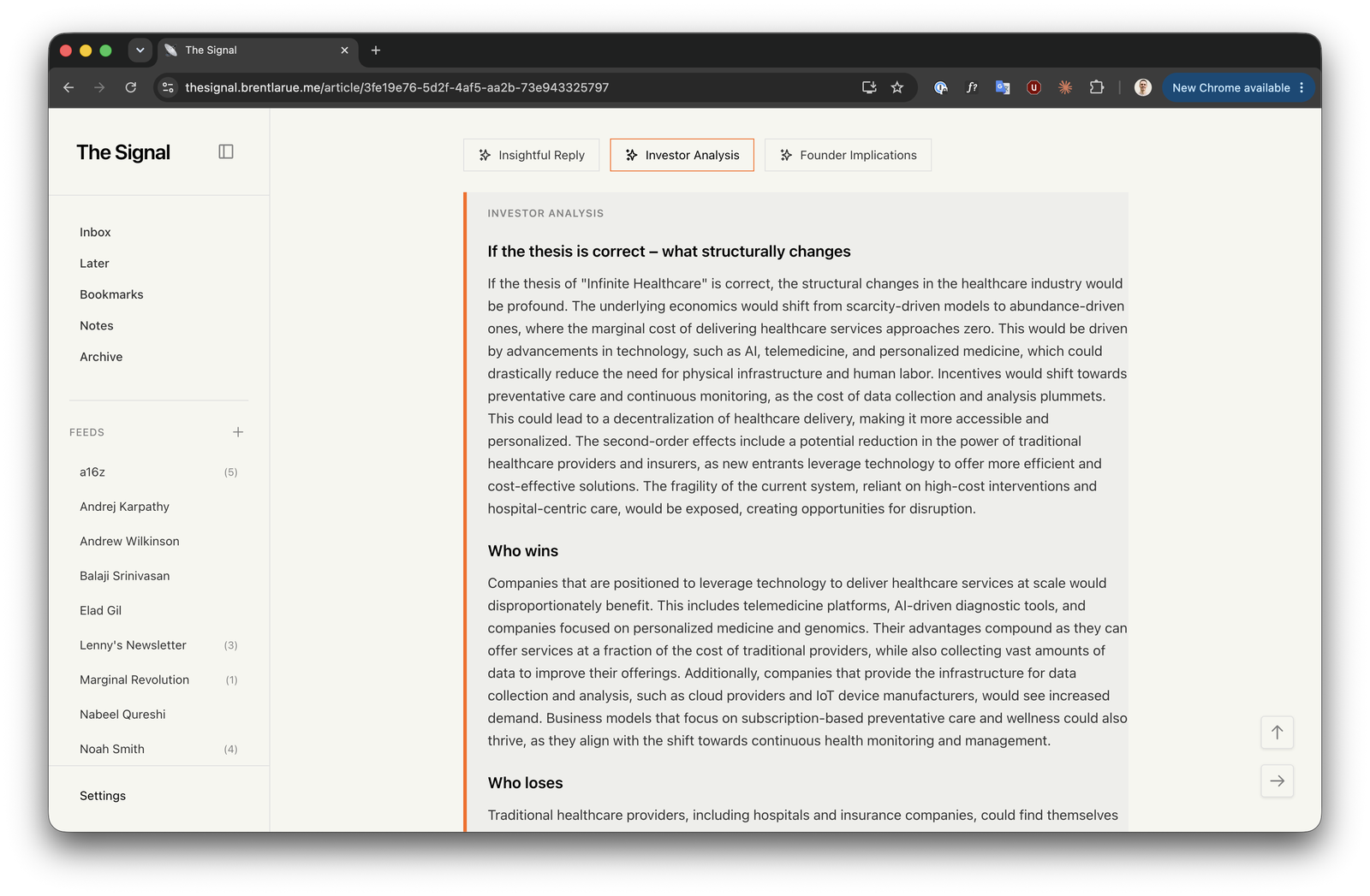
The investor lens. It doesn’t summarize, which took a dozen rounds.
In January I went further and built a daily brief. It gathered the day’s new articles, summarized them, converted the lot to speech with ElevenLabs, and played it back like a news bulletin. Full-screen player and everything. It was manually triggered, because generating one every morning would have burned tokens on the days I don’t read.
One detail in it is the best argument I have for building things for yourself. I specced the intro to open with the date, the number of articles waiting, and a line of encouragement. So it told me I move through the world calm and focused, read me Stratechery, and signed off with “stay sharp, I’ll see you tomorrow”. No product manager on earth would approve that spec. It’s my app. It shipped, and starting the day that way worked better than I expected it to.
People underrate this about personal software. You can name a feature “cull the herd” and have it quietly archive all but the five newest articles in a feed. You can ship a theme that exists as a joke. You can be unserious about the copy and completely serious about the line height. Nothing has to survive a review. So the good instincts get through along with the silly ones, and the good ones are usually the first thing a review would have argued away.
It’s finished, in the sense that anything is. Built end to end, deployed, behind auth, invite-only with email or Google sign-in. A few friends use it. They bring their own API keys, so their tokens are their problem, which is the sort of decision you make when there’s no business model to protect. They started asking for things, so there’s a feature request form inside the app now, and a list. I’ve built some of it. It runs on a free tier, so it sleeps, and the database pauses if nobody visits for a week. That’s fine. It’s a reader, not a service.
Here’s what I actually took from it.
Product builder is a real category and it’s new. If you’ve spent years in product design or product management, you already hold the expensive half. Taste, judgment about what to build, the ability to tell when something is subtly wrong. What was missing was execution without a team, and that’s the part that just arrived. It isn’t that AI writes code. It’s that the distance between seeing exactly what a thing should be and having a running version of it went from weeks to an afternoon.
The fastest way to work is lighter than you’d think. Rough screens plus prompts beats a detailed spec every time. I sketch just enough to be unambiguous, drop the image into the prompt, and describe behavior instead of implementation. I tried doing it properly through the Figma MCP. It still leaves a lot to be desired. Screens and words are winning.
And the thing nobody puts in the productivity posts. Building is exceptionally fun again. Not satisfying. Not productive. Fun, the way it was when all of this was new. Everyone I talk to who has gone hands-on this year says the same thing.
I’ve had a line about this for years, since long before any of it. The more fun you have building something, the more fun people will have using it. I’ve never found a counterexample. It’s why the joke theme and the daft feature names aren’t a distraction from the work, and it’s the reason one hour turned into eight months.
I’m not going to argue from one hour that I’m the right person for a product builder role. The internet is full of arguing. The reader exists, it’s deployed, my friends use it, and the commit history has timestamps on it. That seemed like the better version of the claim.
The rest of the eight months is a longer story and I’ve written it separately. This was the first hour of it.